_edited_edited.png)
_edited_edited.png)
Boulder #45 > Columbia #14 > Boulder #14
About our lodge
boulder #14
About us
100+
Boulder #14 Members
1867
150+ Years of History
6M+
Freemasons worldwide
5,000
Colorado Masons

RWB Kevin
Townley
1952 - 2024

About Boulder #14
Our History
Columbia #14
Columbia Lodge No. 14 was granted dispensation on December 17, 1866 being sponsored by Black Hawk Lodge No.11. The dispensation was granted to twelve pioneer gold miners of Columbia City who thereby became our Masonic fathers, and to A. ]. Van Deren, fourth Grand Master (1864) of Masons of Colorado, who was designated Master of the Lodge Under Dispensation but who served as Master only at the opening meeting on January 3, 1867.
The town of Columbia City was short lived and the lodge asked permission to move to Boulder which was granted on October 7, 1868 one year after receiving its charter. Valmont Lodge had been working under dispensation and affiliated with Columbia.
In 1899, thirty-one years after Columbia Lodge No. 14 left its birthplace in Columbia City to survive a depressed economic situation, sufficient prosperity returned to that place to enable another group of miners to form another Masonic Lodge there in a revived town then called Ward. But after 25 years mining again became so depressed that the second Lodge, Mount Audubon, No. 107, felt unable to continue. So in 1924 it was permitted to move to Boulder and consolidate, just as Columbia, had done 54 years before.
The Lodge had the experience of moving from one town to another, absorbing two other lodges and also meeting in nine different halls. The last home of Columbia, had its cornerstone laying on September 10, 1949.
Boulder #45
The Grand Lodge chartered Boulder No. 45 on September 21, 1881. M. W. Bro Wyman constituted the lodge and installed its officers two days later. Charter members had affiliated from Wisconsin, Iowa, Vermont, Massachusetts, Georgia, Michigan, Ohio, New York, Maine, Illinois, Pennsylvania, and other Colorado lodges.
The first joint installation of officers with Columbia No. 14 occurred in 1884 and has continued until the present. The installing teams have had long periods of service. M. W. Bro. J. A. Davis ended 21 years as installing Grand Master in 1930 W. Bro. Sam Wylam served as installing Marshal for 20 years ending in 1935. Since then M. W. Bros. C. Wheeler Barnes and William R. “Pop” Arthur have officiated most of the time.
The cornerstone of the first Masonic Temple was laid on March 19th, 1894. Three special trains brought visiting Masons.
The two lodges conferred the Third degree at Grand Lodge in 1897. In 1913 Grand Lodge officers came to Boulder and conferred the same degree at a joint communication. Grand Lecturer Wm. W. Cooper acted as Worshipful Master.
Fire destroyed the Boulder Temple in 1944. A new Temple was built with members donating stone, lumber, and other materials and the members offering their services as “operative Masons.” The attractive, well-designed building was free of debt in 1952.
In 2018, Columbia #14 & Boulder #45 merged to form Boulder #14


Masonic Values
Principles of freemasonry
KNOWLEDGE
Above all, what a Mason seeks is Knowledge. In Freemasonry, this quest for answers to live's mysteries is symbolized by the pursuit of "Light".
Initially, Masonry presents itself as secretive, mirroring life's own enigmatic nature. Just as reality's mysteries are shrouded in darkness, so too are the inner teachings of Masonry veiled to the uninitiated.
However, this secrecy isn't an end but a beginning — a challenge that invites the seeker to delve deeper. The quest for answers to these secrets is what constitutes the Masonic journey towards "Light."
A Freemason views the unknown not as an obstacle but as an opportunity for learning. Much like a medieval knight on a quest for the Holy Grail, he embarks on this journey with courage, trusting in both God and his brethren in Masonry.
FRIENDSHIP
Freemasonry profoundly values friendship, seeing it as the mortar that binds the brotherhood together. Within the lodge, Masonry mirrors reality by acknowledging that it's not possible to like everyone; personalities clash, and differences exist.
However, through the Masonic value of friendship, members are encouraged to set aside these differences, fostering an environment of mutual respect and support. This belief further carries to the word at large.
This ethos is practiced through shared rituals and teachings that emphasize brotherly love and unity. In Masonic gatherings, from the lodge to social events, the spirit of camaraderie is ever-present, transforming potential conflicts into opportunities for deeper understanding and connection. In Freemasonry, one truth stands out: there are no strangers, only friends you are yet to meet.
BELIEF
Perhaps the most stringent rule in Freemasonry is that to become a Mason, one must believe in God or a Higher Power, though no specific religion or faith is required for membership. It is also worth noting that Freemasonry IS NOT a religion.
This requirement often leads to misconceptions among those who are not well-informed, giving the impression that Masonry is a "melting pot" of religions. However, this is a misunderstanding.
Masonry encourages each man to adhere to his chosen faith, with the belief that exposure to other perspectives will not undermine his own beliefs but rather might reinforce his understanding of them. This approach mirrors how ancient traditions and cultures once functioned, and Freemasonry has preserved this tradition since time immemorial.
Ancient Freemasonry
The Masonic Apron
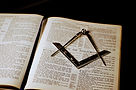
Freemasonry takes its roots from the medieval guilds of stone masons, adopting their symbols and tools, not just for their literal use, but as emblems of deeper wisdom. The apron, the compass, and the square, once tools of the operative mason, now serve as symbols for moral and metaphysical teachings within Freemasonry. In those times, trades like metalwork, carpentry, and masonry were far from ordinary; they were seen as reflections of the divine act of creation itself.
Craftsmen of the past understood their work as an art form, a way to mimic the divine architect's design on a smaller scale. Every task, from laying a stone to forging metal, was imbued with symbolic significance, suggesting that all labor could be a conduit for wisdom and universal truths. Freemasons have carried this tradition forward, using the craft's symbols to teach lessons about morality, brotherhood, and the human condition, making the lodge a place where every tool and ritual is a lesson in living a virtuous life.
While Freemasonry shares a universal language of degrees, symbols, and meanings, there are variations across different jurisdictions. For instance, in Colorado, the Masonic apron deviates from the typical, ornate imagery often associated with a Masonic apron. In Colorado the apron must adhere to three criteria. It must be: Plain, White, and Unadorned.
_edited_edited.png)
Secrecy and Knowledge
Why is Masonry so Secretive?
If you've ever been intrigued by the enigma of Freemasonry, you're not alone. The air of secrecy surrounding us often leads to assumptions of hidden motives. However, the truth is more layered. Secrecy, at times, is simply about preserving the magic of discovery, much like the anticipation of a surprise.
Consider a Masonic lodge as a microcosm of the universe itself. The secrecy surrounding a Masonic Lodge is symbolic of the mysteries of the cosmos - inviting us to explore the unknown. This isn't about exclusion but about the journey of enlightenment. In Freemasonry, we refer to this quest for understanding as seeking "Light."
Here, the lodge becomes a place where, through a continuous quest for greater knowledge, the mysteries of Masonry are gradually revealed to the initiate. This process allows the Freemason to view the world from a new perspective, different from the one held before. Like a scientist formulating theories to explain phenomena, each step in a Freemason's journey illuminates the world in new ways.
We invite those curious and brave enough to delve into what lies beyond the veil of the unknown. Here, you'll embark on a path of discovery, where each question answered leads to new insights. Like a medieval knight in search of the holy grail, you venture forth with bravery, placing faith in God and fellow Masons. If you're ready to join a community dedicated to personal betterment and the exploration of life's mysteries, Freemasonry offers a profound journey. Come, ask your questions, and let us explore together the vast, uncharted territories of knowledge.
2026 Lodge Officers
Meet our lodge officers

Roger Lawley
Worshipful Master

David Clark
Senior Warden

Adam Jabs
Junior Warden
John Werpy
Treasurer

Lance White Horse
Secretary
Tim Werpy
Senior Deacon

Brent Vander Pol
Junior Deacon

Tony Clark
Chaplain

Dick Werpy
Marshal

Juan Milan
Tiler

Mike Tims
Grand Lodge Representative